
Additive Manufacturing and Industrial 3D Printing Services
DEMGY Normandie Additive manufacturing is no longer confined to prototyping. Building layer by layer, straight from a CAD file and without tooling, now makes it possible to deliver functional parts in small and medium series, in geometries no mold could ever release. DEMGY Group has structured this capability around the DEMGY 3D Workshop, a multi-technology facility dedicated to series production of components in high-performance and bio-based polymers, shipped worldwide.
The DEMGY 3D Workshop: 4 stations, 3 technologies
Located on the Saint-Aubin-sur-Gaillon campus, the DEMGY 3D Workshop brings together 4 printing stations across 3 complementary technologies (2 EOS P 810, 1 HP Jet Fusion 4200 and 1 9TLABS), selected according to the material and the intended function. The implementation of these technologies relies on specific expertise provided by the additive manufacturing divisions within the DEMGY Group.
Carbon-filled PEKK laser sintering - EOS P 810
DEMGY Group was the first European manufacturer to acquire the EOS P 810 laser sintering machine for EOS HT-23 material, installed in 2022. This powder is based on Arkema's PEKK Kepstan®, an extreme-performance polymer, reinforced with carbon fiber.
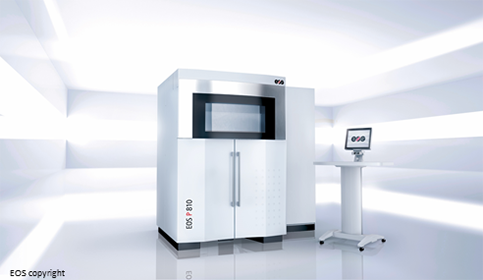 With a build volume of 700 x 380 x 380 mm, the EOS P 810 produces functional parts directly from CAD data, with no tooling required. The resulting components combine high strength with low weight and withstand temperatures well above 200°C. The system is the first laser sintering solution designed for series production of demanding parts in high-temperature PEKK polymer.
Bio-based PA11 printing - HP Jet Fusion 4200
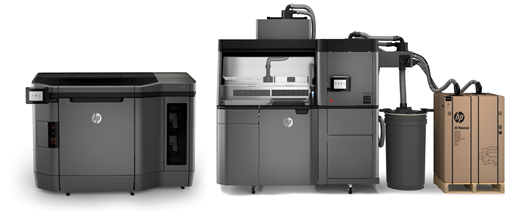 One HP Jet Fusion 4200 stations handle series production in polyamide 11 Rilsan®, manufactured by Arkema from castor oil — a 100% bio-based high-performance polyamide. Running two machines secures throughput on PA11 production runs.
Parts built from these fine powders offer superior mechanical properties and reduced weight compared with polyamide 12, along with excellent impact resistance and greater ductility and elasticity.
Continuous fiber composites - 9TLABS
The 9TLABS machine opens a middle path between additive manufacturing and fiber placement for thermoplastic composites. It prints high-performance composites within a build volume of 350 x 270 x 250 mm:
- Matrices: PEEK, PEKK, PPS, PA12, bio-based PA
- Reinforcement: up to 60% continuous fiber (carbon, glass or basalt)
The technology makes it possible to design structural parts with reinforcement placed only where loads require it. It is generally combined with injection overmolding on less stressed areas, serving structural weight reduction.
The benefits of additive manufacturing
Additive manufacturing integrated into series production accelerates the industrial process from design to fabrication: high-value functional parts are produced up to ten times faster than through conventional routes. According to IDTechEx's Polymer Additive Manufacturing 2023-2033 study, the market is projected to reach 21 billion dollars by 2033.
For a design office, the gains are concrete:
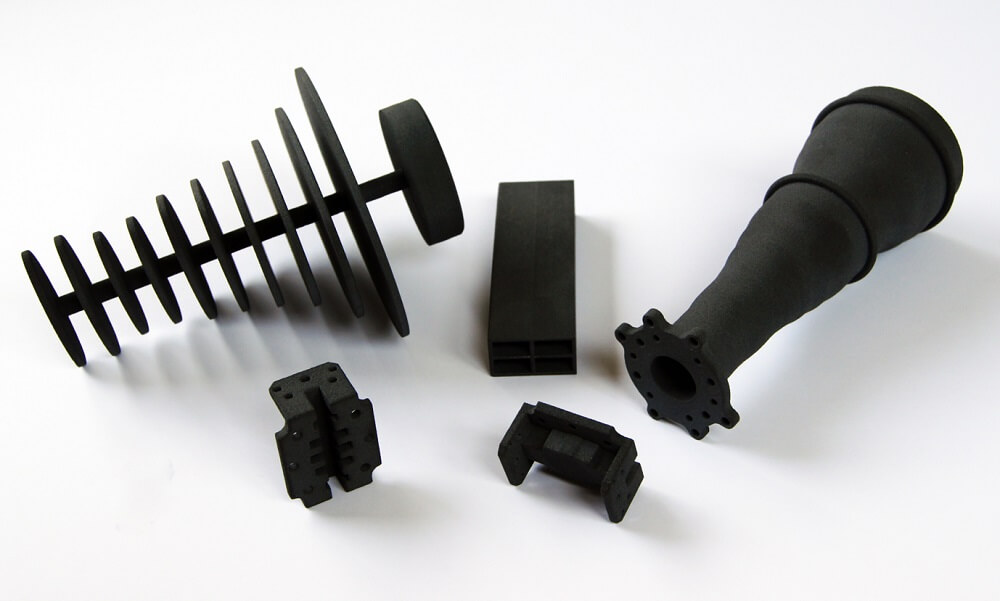 Measurable time savings on time to market,
- Lower costs for prototyping and production in small and medium series,
- The manufacture of complex shapes, built directly assembled straight off the printer,
- Customization without tooling constraints,
- Functional parts with high dimensional accuracy and controlled mechanical properties, produced to the group's quality standards
- Integrated functions: fire resistance, electrical and thermal conductivity, localized stiffness.
Functionalizing printed parts
Every functional part produced through additive manufacturing can be metallized to provide electrical continuity or electromagnetic shielding. DEMGY Group carries out this process in-house, avoiding the subcontracting of a critical operation and keeping control of the chain.
-> Discover metallization and surface treatment
Weight reduction and metal replacement
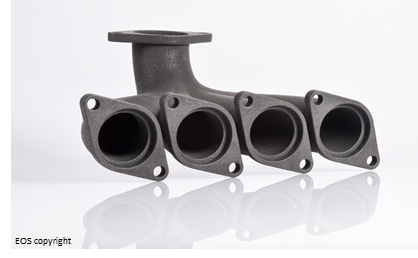 Additive manufacturing feeds directly into the weight reduction and metal replacement strategy pursued by DEMGY Group. It reaches geometries no subtractive process can deliver, while removing tooling costs on short runs. This approach serves aerospace, automotive, defense and industry.
From prototype to series
The group's history with 3D printing goes back to 1995, when it acquired its first Stratasys machine for prototyping. The DEMGY 3D Workshop extends that trajectory toward series production.
The design office identifies the optimal technical solution (affordable, repeatable in series, in eco-material or high-performance material) then supplies a prototype and sampling to prepare the production phase. Projects submitted at the design stage get the most out of the process.
Discuss an additive manufacturing project
To assess the feasibility of a part in polymer or composite additive manufacturing, DEMGY Group teams can carry out a feasibility study and a technical review.